
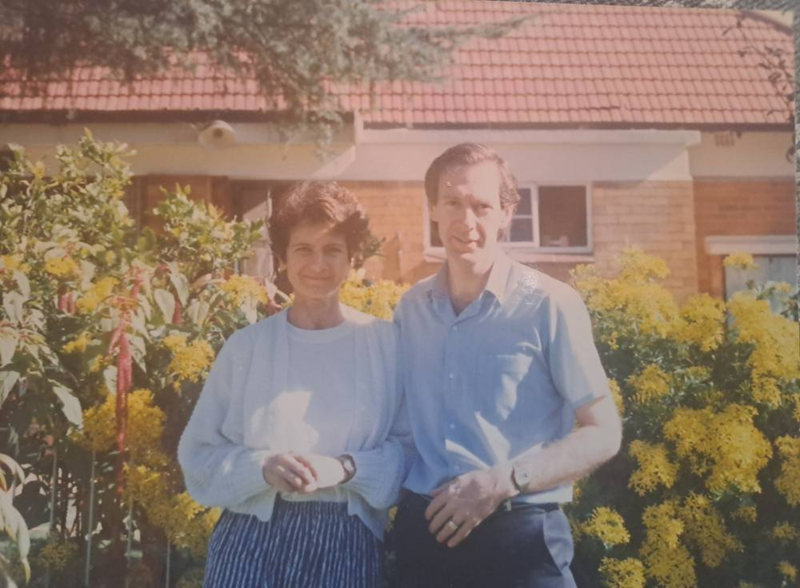

As children, my sister and I were often reprimanded by my mother and told that we must not “play the giddy goat.” I do not know what a giddy goat is. I do know, however, that it is a serious behavioural violation and that it must stop immediately. My mother had some of the strangest turns of phrase. When others would say something mundane, like “that’ll go down like a lead balloon” my mother would say “that’ll go down like a herd of turtles”. I’m not entirely sure how a herd of turtles descends, but it would clearly be troublesome.
Today is the anniversary of her death, and I feel compelled to tell the world about her. She laughed loudly, repeatedly, and without apology, especially when watching Fawlty Towers. She knew every line, every pause, every facial twitch, but still watched each episode as though Basil Fawlty were improvising just for her. She guffawed so hard and so often that one might reasonably have suspected memory loss.
She had a fully developed plan for old age. Under no circumstances was she going to live in a retirement village with a name like Misty Sunsets or Golden Harvest. Those names sounded like surrender. Instead, she intended to become the founder of Funky Bats, a residential community for the elderly who refused to age quietly. There would be compulsory morning aerobics. Those who failed to attend would be called the Bunky Fats, which, I assume, would come with social or punitive consequences. Residents would be sorted into behavioural categories such as Garrulous Gogos, Indignant Oumas, and Grumpy Grandpas. This would not be a joke. It would be a policy, based on performance.
My mother was also a militant health enthusiast. On her deathbed, she made a confession of such magnitude that it shocked us to the core and made us question everything we thought we had known about her: once, years earlier, she had bought a marzipan chocolate from Woolworths and eaten it secretly. On her own. The shame was palpable. This was a woman who believed that wholewheat chocolate cakes were acceptable fare for children’s birthdays and junk food was morally indefensible. My aunt once accepted an omelette at our house and nearly had to be resuscitated. The eggs had been fortified with the previous night’s vegetable water because she was desperate not to waste a trace of dissolved vitamin. Her plain, boiled lentil stew destroyed my relationship with the lousy legumes forever, and my father claimed that when she served us her health drink, we had to sleep with teeth straighteners to stop our teeth from curling. I’m still not entirely sure that this was metaphorical advice.
She adored the Kruger Park. One year, she phoned my father just before his birthday and asked if she could spend a rather large amount of money on his present, as she wanted to take him on a surprise trip. He said absolutely not. She put down the phone, turned to me, and said, “Right, we’ll do it self-catering and spend less.”
On that same trip, she demonstrated her total inability to navigate physical space, a trait, it would seem, that I have unfortunately inherited. We were staying in rondavels arranged in a circle. She went to fetch hot water for tea from a communal kitchen and returned to the wrong family, sat down at their table, and only realised her error when their faces failed to register recognition. We were hysterical. We had been calling and waving at her the entire time while she ignored us with serene confidence.
This was the same woman who was terrifyingly organised. When I got married, she produced lists for everyone, copies of everyone’s lists in case they lost them, and a master list of all the lists. Order was not optional.
She could not tolerate mess. One day she announced that the house was overrun with “heaps of rubble.” My father asked for specifics. “It’s knee-deep in rubber bands!” she shrieked in horror, arms flailing in wild gesticulations. There was, in fact, a single rubber band on the floor, which had fallen off the newspaper while my father was reading it. Civilization was clearly collapsing. Perhaps this was an embryonic heap.
But her greatest gift was her humour, which was sharp and merciless in the best way. Once, a neighbour put a letter in our post box, which said, rather scathingly, “Congratulations. Your grey cat is the father of 5.” My mother refused to accept such slander. She wrote a reply that went something like this:
I am horrified that you would cast aspersions on the ethical character of my cat. My cat shall not be vilified, and I shall not allow besmirchment through spurious allegations. I can confirm that this is a cat of the highest integrity and moral fibre.
P. S. She is also a spayed female.
It has been twenty-four years since my mother died, but the older I get, the more I realise how much she has impacted who I am. I get lost in straight lines and even more so in circular buildings. I distrust lentils deeply. I can’t restrain myself from sarcasm and cynicism. And when I eventually grow older, louder, more opinionated, and increasingly uncooperative, I know exactly where I belong. In Funky Bats.