
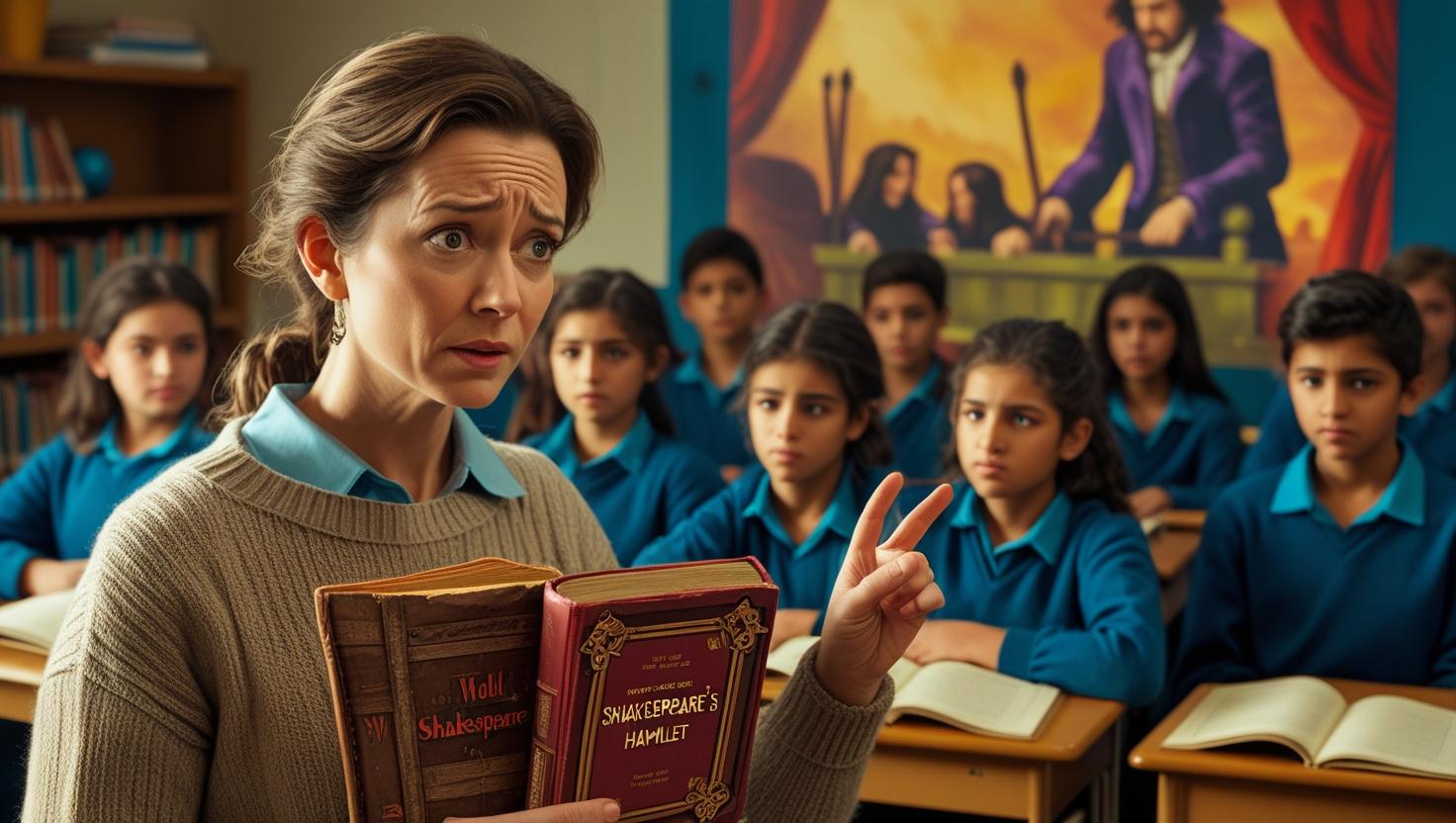

Teaching Shakespeare in schools is touted as an endeavour of immense educational, cultural, and intellectual merit. This claim is made with such regularity and reverence that to question it feels almost sacrilegious. The Bard, we are told, offers unparalleled insight into the human condition. His plays brim with love, betrayal, ambition, downfall, identity - those universal themes that supposedly resonate with every teenager gripping a study guide in mild despair. Macbeth prompts introspection about power and guilt. Romeo and Juliet invites teenagers to marvel at the destructive force of adolescent emotion. So far, so good. But I often wonder if these moments of resonance are more aspirational than real.
Shakespeare is frequently held up as the ultimate tool for sharpening critical thinking skills. His linguistic wizardry, full rhetorical finesse, is meant to dazzle pupils into analytical dexterity and loquacious brilliance. In practice, however, it rarely plays out that way. Even among the academically adept, there is often only the faintest flicker of understanding. Any real engagement must be coaxed, cajoled, and ultimately spoon-fed. Pupils mutter, “What does that even mean?” while they wrinkle their noses with a mix of exasperation and boredom. English teachers, ever valiant, respond with monologues of their own, explaining every sentence and acting out each character melodramatically until our classes can finally scribble something faintly coherent in their essays.
Any English teacher worth their red pen can attest to the sighs, the eye-rolls, and the theatrical groans that echo around the classroom when a Shakespeare lesson begins. We are the unwitting salespeople for a product that requires extraordinary persuasion just to get pupils to stop actively disliking it. Once their resistance is softened, the real work starts: transforming a 400-year-old text into something palatable. At times it feels less like teaching and more like interpretive hostage negotiation. We translate, scaffold, and summarise. We hold pupils’ hands across a linguistic canyon that even teachers occasionally fall into. It is an uncomfortable reality that not every teacher has mastered Shakespeare. They nod through unfamiliar phrases and obscure references, quietly hoping no one asks what “bare bodkin” means. If the adults in the room are floundering, how can children be expected to extract anything meaningful?
Defenders of Shakespeare argue that he is essential for cultural literacy. He is a foundational figure in the canon, a writer whose influence underpins everything from modern cinema to political speeches. His shadow looms large. He is the original meme-maker, the inventor of star-crossed lovers, ambitious anti-heroes, and mistaken identities. Yet the question remains: is that enough to justify forcing his work upon a captive teenage audience, year after year? Can we still claim cultural relevance when most pupils are simply memorising study guide summaries and hoping the essay question will be about the dagger?
Many pupils, particularly those not aiming for top marks, disengage completely and immediately. The “A” candidates will comply. For the rest, Shakespeare becomes an obstacle. They flick through modern translations, regurgitate a few approved thematic statements, and forget the entire play as soon as the exam is over. Meanwhile, teachers are drained, pupils remain unmoved, and vast stretches of curriculum time have been consumed by a literary ritual that offers little return.
Ask any kid how many new words they’ve gleaned from studying Shakespeare. Most will hesitate. The confusion sets in as they try to distinguish “thee” and “thy” from “thou.” Though we insist on the value of teaching the original text, most pupils lean on modernised versions anyway. Is that genuine language acquisition, or are we simply acting out a centuries-old charade?
We are told, again and again, that the themes are universal. Of course they are. But so are the themes in every other halfway-decent play or film. Universality is not Shakespeare’s exclusive territory and many contemporary and diverse texts are being side-lined to make space for yet another soliloquy.
Should we cast Shakespeare out entirely? Absolutely not. That would be a tragic loss. The real issue lies not in what we teach but in how we teach it. Shakespeare was never written for silent classrooms under fluorescent lights. He wrote for performance, for gesture, for the raucous energy of a crowd. Teaching his work as if it were scripture rather than theatre strips away its vitality.
It is also time to re-evaluate our linguistic purism. A well-crafted adaptation that preserves metaphor and nuance can engage pupils far more meaningfully than a page of untranslated iambic pentameter. Shakespeare should remain in the curriculum, but not as its immovable centrepiece. His plays should be used to spark curiosity about storytelling, character and rhetoric, not serve as an endurance test.
However, there are pupils who relish the linguistic complexity, who light up at the challenge of decoding Shakespeare’s verse and unpicking its layered meanings. For these who genuinely aspire to literary depth, there is value in grappling with the unadulterated text. It is to them that we should offer Shakespeare and develop an appreciation for rhetorical craft and the thrill of discovering centuries-old stories. Shakespeare should absolutely be on offer, perhaps through elective modules or enrichment programmes. But this should not dictate how we teach the entire cohort. Classroom time should not be dominated by a slow, painful wade through unfamiliar language that alienates more than it enlightens. Instead, we should teach the spirit of Shakespeare through performance and adaptation, reserving the full linguistic immersion for those who are equipped and eager.
So verily, I say unto thee, there be scrolls and writings of such puissant tongue and potency that they shall upheave the very firmament of our literary understanding. We must needs forswear this custom of yoking English letters to Master Shakespeare alone, as though no other quill did ever ink wisdom or wonder. I speak not to besmirch the Bard, for he is full worthy and richly crowned with laurel, but let us not make of him the sole sun ‘round which all lesser lights must orbit. Grant other voices leave to speak, that the choir of literature may sound more full and fair.
Makes sense, doesn’t it?
I ABSOLUTELY agree! Shakespeare is meant for performance and should be treated as such. I LOVE teaching Shakespeare but a lot is lost on the pupils if you painstakingly translate every word. He has his place, he is a master and his works belong on the stage to be appreciated as such.